Saturday, January 12, 2013

20. Memory Wreath: Emily Wilding Davidson

Memory Wreath
By Becky Brown

Mary Richardson of the Women's Social &
Political Union slashed a Velasquez 
nude in the National Gallery in 1914.


The year 1913 saw increasing militancy among women demanding the vote, particularly in England. WSPU members had been using civil disobedience to focus attention on their demands. Using tactics learned from the anarchist movement, members began to focus on "The Deed," acts of terrorism .

Houses of opposing politicians were torched.


The most shocking event was the death of Emily Davison who stepped out onto England's Epsom Downs track in front of the King's horse in the middle of the Derby, the June social event. The horse tossed her into the air and she died of her injuries a few days later. Jockey 22-year-old Herbert Jones was knocked to the ground but he and the horse suffered no significant physical injuries.


Was Emily's dramatic act an accident, a suicide or a protest gone awry?  She was a well-known militant in the WSPU. She'd been to jail several times, tried suicide before and had been accelerating her own rebellion by setting fires and throwing stones at government officials.


Emily Davison at 40, a month before she died
 
WSPU leader Sylvia Pankhurst wrote in her memoir that Emily and her roommate had planned "a Derby protest without tragedy - a mere waving of the purple-white-and-green at Tattenham Corner, which, by its suddenness, it was hoped would stop the race. Whether from the first her purpose was more serious, or whether a final impulse altered her resolve, I know not." Emily's  funeral befitted a martyr with 6,000 mourners walking through London's streets.


Emily Davison on the right with WSPU leaders
Emmeline Pethick-Lawrence at left and sisters
Christabel and Sylvia Pankhurst

The King's jockey Herbert Jones said he was haunted by the memory of her face. When WSPU leader Emmeline Pankhurst died after the cause had been won, he left a wreath with the message, "To do honour to the memory of Mrs Pankhurst and Miss Emily Davison." He committed suicide in 1951.

Memory Wreath by Georgann Eglinski


Try using BlockBase #2039
and add lines to make triangles in the corners in EQ...
or see BlockBase #2392 with the block on point.


Memory Wreath is a pattern from Ruth Finley's 1929 book Old Patchwork Quilts. She described it as a mourning block often made from the clothing of the departed. It's a variation of BlockBase #2039 also called King's Crown by the Kansas City Star.


Cutting an 8" Finished Block
A - Cut 8 squares  2-7/8".
Cut each in half diagonally to make 2 triangles. You need 16 triangles.
B - Cut 1 square 5-1/4" (5-3/16" if you want to use the 1/16th inch default.)

 Cut with 2 diagonal cuts to make 4 triangles. You need 4 triangles.

C - Cut 1 square 4-1/2"

Memory Wreath by Becky Brown

12" Pattern


A century ago movie cameras recorded Emily Davison's martyrdom and her funeral. Click to see one version of the Derby catastrophe:
And here is her funeral procession:
http://youtu.be/Tbjzs8v6qsg 

Decades later the BBC interviewed an eye witness to the act:
http://www.bbc.co.uk/archive/suffragettes/8317.shtml


Tea House at Kew Gardens after arson by militant suffragettes.
Library of Congress

Read more about this image at a Library of Congress site:
http://www.flickr.com/photos/library_of_congress/2765476716/

Saturday, January 5, 2013

19. Old Maid's Ramble: Desperate Walkers


Old Maid's Ramble
By Becky Brown

The country in Hampshire, England

One of Jane Austen's delights was walking across the countryside from village to village. A few days after her 23rd birthday in 1798 she wrote her sister Cassandra:
"I enjoyed the hard black frosts of last week very much, and one day while they lasted walked [from Steventon] to Deane by myself. I do not know that I ever did such a thing in my life before."

 Less than two years later the hike of a few miles was commonplace for Jane.
"On Thursday we walked to Deane, yesterday to Oakley Hall and Oakley, and to-day to Deane again. At Oakley Hall we did a great deal—eat some sandwiches all over mustard... ."

A month later at her friend Martha Lloyd's house, the weather kept them inside.
 "It is too dirty even for such desperate walkers as Martha and I to get out of doors, and we are therefore confined to each other's society from morning till night..."
Desperate walkers Jane and Martha were perhaps considered eccentric. Ladies did not hike. About one hundred years later walking was still ill-advised. In 1896 health expert John Madison Taylor warned against it. Girls should "take mild open-air exercise (of which walking solemnly along the street is emphatically not the best and not even a good form)."

Advice such as Taylor's was still in vogue when I was a teenager in the 1960s. Exercise of any kind seemed unwise (female troubles, you know) and unladylike (boys hated competition).


According to Taylor: 
"The so-called calisthenic exercises, which mean 'beautiful forcefulness,' probably because they are usually so hideous, are devoid of interest and not particularly useful. Only that exercise is best which involves some pleased acquiescence.... Fancy dancing, as previously remarked, admirably develops loins and back....The bicycle is monotonous, and the character of movements is restricted by the rotary mechanism, hence it develops unsymmetrically and may exhaust before tiring the muscles. Cycling is a peril because of the competition of companions who lure the weak ones too far. Girls should not push up steep hills and never attempt to keep pace with powerful young men."

1911---A Kansas sports team from the Library of Congress
 
I'm sure Taylor recommended housework too. I'm jealous of American girls who went to high school after Title IX was enacted in 1972. Within a few years girls' participation in team sports went up from 4% to 25%. At last summer's Olympics, women won 56% of Team USA's medals.


"[Brother Henry] talks of the Rambles we took last summer with pleasing affection." Jane Austen, April 11, 1805

Old Maid's Ramble
By Becky Brown
She threw in more fabrics in this version:
"I always think more fabrics are better!"

Celebrate a good hike with Jane, Martha and Old Maid's Ramble. The pattern was given the unfortunate name about 1890 by the Ladies Art Company.
It makes a great two-color block

It's BlockBase #2328a.
Oops! Ginny says #2338a and she's right, but I
can't get it to find the number. Search as a wild card
for Ramble and you'll see it.
 
Cutting an 8" Finished Block
The red measurements come from the EQ rotary cutting default set to 1/16th inch rather than 1/8".
 
A - Cut 12 squares 3-1/4". Cut with 2 diagonal cuts to make 4 triangles.
You need 48 triangles.
B- Cut 1 square 5-1/4". Cut with 2 diagonal cuts to make 4 triangles.
You need 4 triangles.

Here's a how-to for a two-color version. Throw in more fabrics and refigure the shading.


Cutting a 12" Block
A - Cut 12 squares 4-3/16". Cut with 2 diagonal cuts to make 4 triangles.

You need 48 triangles.


B- Cut 1 square 7-3/16". Cut with 2 diagonal cuts to make 4 triangles.

You need 4 triangles.


Read about the benefits of Title IX mandating girls' sports here:
Remember early concepts of exercise in John Madison Taylor & William Hughes Wells , Manual of the diseases of children. Search for the words feebleness or puberty.
And read Jane Austen's letters in a Project Gutenberg e-book here:

Saturday, December 29, 2012

18. Cheyenne: Wyoming Firsts

Cheyenne
By Becky Brown

Wyoming was the first U.S. territory and subsequently the first state to legislate women full rights to vote and hold office. In 1869 the territory approved universal adult female suffrage. Cheyenne is the state's capitol city.
Women voting in Cheyenne made news
in Frank Leslie's Weekly, 1888.

Wyoming was a pioneer in votes for women, followed by other Western states and territories. Here the west provides a beacon for eastern women, who are drowning in a sea of powerlessness.

Women's suffrage came first to the Western states for many reasons. It may be that pioneers settling a new territory are more innovative by nature. Frontier communities usually have few women so perhaps the ruling men perceive their voting bloc as less of a threat. Wyoming, still the most sparsely populated state, was hoping to attract more female settlers.  "We now expect at once quite an immigration of ladies to Wyoming," cheered the Cheyenne Leader.


Esther Hobart Morris (1814-1902)

Inspired by a gold rush, Esther Hobart Morris came to Wyoming from Illinois in 1869 with her husband. Like many other suffrage pioneers she'd learned techniques of reform politics through involvement in the antislavery movement. She effectively lobbied the legislature in Cheyenne with the strategy of attracting female settlement with the promise of equal opportunity.

In 1870 Esther Morris was appointed to a minor government job in the gold-mining town of South Pass City. This post as female justice of the peace was considered the first government position by a woman (although one has always to be wary of the accuracy of "firsts").


Wyoming achieved a truly documentable first when Nellie Tayloe Ross became the first female governor in 1925.*
(*Although there is an asterisk here---she was appointed to the office after her husband died in the job. She lost the re-election campaign a  year later when she ran on her own.)

Cheyenne by Georgann Eglinski
Cheyenne by Becky Brown

 Cheyenne, given that name by Hearth and Home magazine about a hundred years ago, can remind us of Wyoming's firsts.

 BlockBase #2113

Cutting an 8" Finished Block
The red measurements come from the EQ rotary cutting default set to 1/16th inch rather than 1/8".

A - Cut 6 squares 2-7/8".
Cut each in half diagonally to make 2 triangles. You need 12 triangles.
B - Cut 8 squares 2-1/2"
C - Cut 1 square 3-3/8" (3-5/16")


Cutting a 12" Finished Block

A - Cut 6 squares 3-7/8".


Cut each in half diagonally to make 2 triangles. You need 12 triangles.

B - Cut 8 squares 3-1/2".

C - Cut 1 square 4-3/4".

Cheyenne by Dustin Cecil
Dustin and Georgann shaded the block to look more like a pinwheel.

Saturday, December 22, 2012

17. Mother's Delight: Christabel Pankhurst

Mother's Delight
By Becky Brown

Christabel Pankhurst (1880-1958)


England's suffrage movement is personified in the Pankhurst family. No one had more influence on radical tactics, politics and propaganda than Christabel, the eldest daughter of a political family. In 1936 the King honored her for her leadership by appointing her a Dame Commander of the Order of the British Empire
 Christabel's mother Emmeline Pankhurst, (1858-1928)

In 1903 Emmeline Pankhurst and her three daughters, Christabel, Sylvia and Adela, rebelled against the old-school National Union of Women’s Suffrage Societies (NUWSS) to form the Women’s Social and Political Union. Their motto: "Deeds Not Words." WSPU deeds began with disruption that resulted in arrests and accelerated to hunger strikes, arson, bombs, assault and death threats. 


Emmeline and Christabel ignited religious fervor in WSPU members. Christabel, who had long been the center of her mother's life, became the center of the movement. For a decade her skills in publicity, in capturing press attention and her ever-increasing militancy transformed a polite, ineffective campaign into a terrorist cell of extremely well-dressed women. In 1913 a WSPU member died after throwing herself in front of a horse in the Derby race. The same year unknowns bombed politician David Lloyd George's home.

Marci H alternated blocks with crazy blocks and printed photos.
See her very effective project in her Flickr album here:

In 1914, the year World War I called a halt to their crusade, suffragettes slashed museum paintings with meat cleavers. A statement by a WSPU member:
 "I have tried to destroy a valuable picture because I wish to show the public that they have no security for their property nor their art treasures until women are given political freedom."

A 2-color version of Mothers Delight.
It took me a while to figure this out.

 Vera Brittain in boarding school during the early teens remembered the WSPU.
"The name of Mrs Pankhurst was a familiar echo in my school days...an echo that grew louder as her exploits gathered publicity." Vera listened silently at her mother's tea parties to the older women criticizing the "suffs" as a "screaming sisterhood."

Emmaline Pankhurst with Christabel and Sylvia,
 a photo capturing Christabel's charisma and Sylvia's lack.
 
Adela Pankhurst (1885–1961)

When she criticized their tactics Adela was given a one-way ticket to Australia by her mother and eldest sister. "One of Adela is too many," was Christabel's opinion. Adela never saw them again.
Portraits of the Pankhursts were sold at the WSPU shop.
Emmeline's is topped by the official colors.
 
It is hard to imagine the fight for the vote without the Pankhursts but reading their biographies raises second thoughts about ranking such obsessive and manipulative women as heroes.

Did the Pankursts and the WSPU hurt or harm the cause, or were they irrelevant? First-person accounts by a variety of English people reveal how little their presence affected the lives of the average person. Women in the United Kingdom obtained the right to vote (property owners over 30) in 1918, four years after the WSPU ceased suffrage activities.


Monument to Emmeline Pankhurst in
Victoria Towers Gardens, erected in 1930

The Pankhurst Girls about 1890

Mother's Delight
By Becky Brown

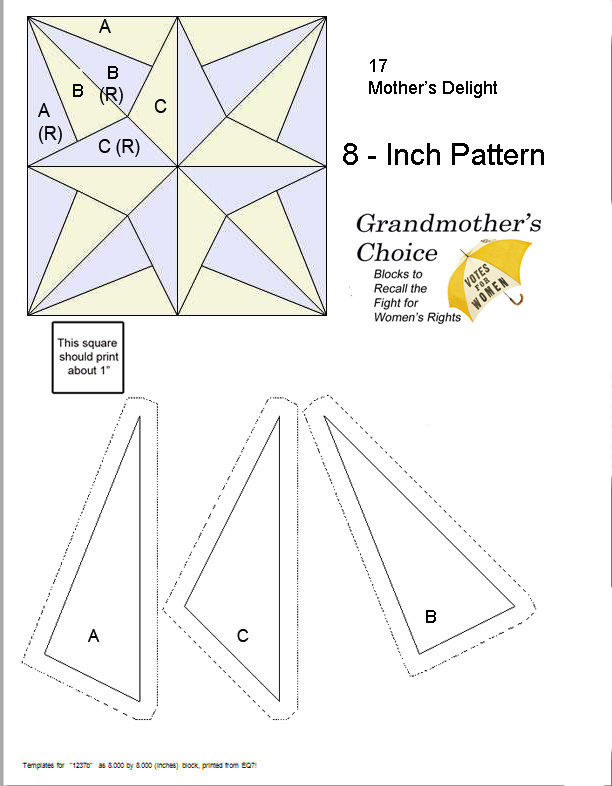
Yet we can remember how one family radicalized the movement and dominated the publicity with Mother's Delight, a pattern published by Carlie Sexton in 1930.

 BlockBase #1237b
(If you want to search by number for the pattern in BlockBase remember to add the b.)

Cutting an 8"  or 12" Finished Block

The block is cut using 6 templates (3 shapes, each flipped). Cut 4 of each.

See the patterns for two different sizes. The 8" pattern includes seams. The 12" pattern does not, so add them.


It's fairly easy to piece if you can keep the direction of the pieces straight. Lay it all out before you stitch.

Mother's Delight by PIP at RestIsNotIdleness
   
Mother's Delight
By Dustin Cecil
Read Emmeline's side of the fight here:
My Own Story by Emmeline Pankhurst
And Sylvia's here:
The Suffragette: The History of the Women’s Militant Suffrage Movement  by Sylvia Pankhurst
See the 1974 BBC mini-series Shoulder to Shoulder about the Pankhursts.
Here are 2 short You Tube scenes

You can actually hear Sylvia discuss her mother in this 13 minute 1953 BBC program (There is no dish---just a polite summary):
See a set of anti-Pankhurst playing cards here
http://blogs.library.duke.edu/rubenstein/2012/04/09/new-acquisition-panko-playing-cards/

And read a transcript of the May 5, 1914, London Times story about the attack on a Sargent painting:
  http://www.jssgallery.org/Letters/Notes/The_Times_May_5_1914.htm